Florida Marine Tracks vs Navionics: A Regional vs Universal Chart Debate
Understanding two fundamentally different approaches to Florida marine navigation and which one matches your boat, budget, and boating style.
For Florida boaters navigating shallow, complex inshore waters, choosing the right marine chart system can mean the difference between confident exploration and nerve-wracking uncertainty. Two names dominate the conversation: Florida Marine Tracks (FMT by ISLA Mapping) and Navionics.
But here’s what most boaters don’t realize: these aren’t competing products trying to accomplish the same thing. They represent entirely different philosophies. Florida Marine Tracks is a hyper-regional, imagery-driven system with thousands of miles of manually verified low-tide tracks designed exclusively for Florida’s most challenging shallow waters. Navionics is a worldwide digital chart platform offering traditional nautical chart presentation with broader coverage but less local granularity.
This guide breaks down exactly how these systems differ, who each one serves best, and what factors should drive your decision, from hardware compatibility to actual on-water experience in Florida’s flats, keys, and backcountry.
What Is Florida Marine Tracks (FMT)?
Florida Marine Tracks (developed by ISLA Mapping) is a proprietary GPS chart system built specifically for Florida’s inshore, backcountry, and shallow-water navigation. Unlike traditional nautical charts that rely primarily on NOAA depth surveys, FMT combines corrected base maps with ultra-high-resolution aerial imagery (3 inches to 1 foot resolution) and thousands of miles of manually run, verified navigation tracks.
The system covers South Florida (everything south of approximately Sarasota/Sebastian Inlet, including Everglades, Florida Keys, Ten Thousand Islands, Florida Bay) and North Florida (Sarasota/Sebastian northward to Georgia and Alabama borders, including entire Intracoastal, St. Johns River system, and Big Bend area). Full state coverage requires two microSD cards.
FMT’s key differentiator is low-tide verified navigation tracks, meaning routes were physically run at low tide by local captains, providing margin for most conditions. The system works exclusively on Navico hardware (Simrad, Lowrance, B&G) and Raymarine chartplotters, optimized for boats drafting 13 inches or less at rest.
The philosophy centers on showing you exactly where you can safely run, particularly in shallow and complex areas where traditional charts provide limited confidence. High-resolution imagery displays individual mangroves, oyster bars, sand patches, and water color variations indicating depth, with navigation tracks drawn precisely over safe routes.
What Is Navionics?
Navionics, now owned by Garmin and sometimes branded as “Garmin Boating,” is a worldwide marine navigation app and chart system that digitizes traditional nautical charts into interactive formats. It offers coverage across all U.S. waters and internationally, with a focus on providing comprehensive base charts, route planning, and community-contributed data through ActiveCaptain.
The platform works on mobile devices (iOS/Android) and many hardware chartplotters, making it accessible without dedicated marine electronics. For detailed information on how Navionics pricing has evolved, the subscription model now costs $49.99/year for US & Canada coverage.
Navionics provides official NOAA-based nautical charts, SonarChart HD bathymetry with community-sourced depth mapping, dock-to-dock auto-routing, tide and current predictions, ActiveCaptain points of interest and marina reviews, and weather overlays. The system is compatible with Garmin chartplotters, mobile devices, and some other brands.
The philosophy emphasizes universal coverage with familiar nautical chart symbology, allowing boaters to navigate anywhere using standardized chart conventions. Understanding proper marine navigation principles helps boaters maximize any chart system’s effectiveness.
Core Differences: FMT vs Navionics
Coverage and Format
Florida Marine Tracks covers Florida exclusively via physical microSD cards, while Navionics provides worldwide coverage through subscription-based digital access. FMT costs $300-$450 one-time for the chips, whereas Navionics requires $49.99 annually for US & Canada charts.
Chart Style and Presentation
FMT uses aerial imagery as its primary navigation tool, with ultra-high-resolution photography (3 inches to 1 foot resolution) showing actual water appearance from above. You see individual features, channels, and hazards visually. Navionics presents traditional nautical charts with depth contours, symbols, and color coding, using satellite imagery only as an optional overlay.
For boaters exploring what modern chart presentation looks like, understanding how navigation apps compare provides useful context on industry evolution.
Navigation Tracks
FMT’s signature feature is thousands of miles of manually verified low-tide tracks physically run by local captains. These provide instant “local knowledge” for unfamiliar areas, particularly valuable for night navigation, poor visibility, and narrow channels. The track density is exceptional in South Florida but less comprehensive in North Florida.
Navionics offers dock-to-dock auto-routing that calculates paths based on charted depths and navigation aids. The routing is conservative and often avoids perfectly safe shallow areas that locals use, but it works well for offshore passages, coastal cruising, and well-marked channels.
Hardware Requirements
This represents perhaps the most critical decision point. FMT requires compatible Navico (Simrad, Lowrance, B&G) or Raymarine chartplotters, excluding Garmin entirely due to company policy. Units below 7 inches struggle with FMT’s massive data files, with 9-inch or larger displays recommended. If you don’t already own compatible hardware, factor in $500-$1,500 for a suitable chartplotter.
Navionics works on devices you likely already own: iOS devices, Android phones and tablets, Garmin chartplotters, and many other brands. This flexibility eliminates hardware barriers entirely if you’re comfortable with mobile navigation.
Depth Awareness Approaches
FMT’s Verified Track Strategy
Florida Marine Tracks doesn’t display real-time depth readings or adjust for your vessel’s specific draft. Instead, the verified routes were run at low tide, inherently providing safety margin. The aerial imagery helps you visually assess water depth by color and texture, with precise marker locations for channel navigation.
You get confidence that tracks are verified safe for shallow boats, but you don’t get real-time transducer depth readings (requiring a separate fishfinder) or automatic tide adjustments to chart depths. The system assumes boaters understand basic tidal principles and can judge conditions appropriately.
Navionics Traditional Depth Display
Navionics provides NOAA surveyed depths referenced to chart datum, depth contours, SonarChart HD 1-foot bathymetry in mapped areas, and tide predictions shown separately from the base chart. You can customize depth shading options to highlight specific depth ranges.
However, the system doesn’t automatically adjust displayed depths for your vessel’s draft or integrate real-time water levels into the chart view. You manually interpret whether charted depths are safe for your boat at the current tide stage. For boaters exploring modern alternatives, some apps now offer draft-aware depth features that automatically highlight safe versus shallow water based on vessel specifications.
Real-World Florida Use Cases
Everglades Backcountry Fishing
Florida Marine Tracks excels here. Dense track coverage, verified routes through narrow cuts, and high-resolution imagery showing individual mangrove islands make this where FMT shines brightest. Navionics works but provides far less local granularity and confidence-building detail in these complex shallow environments.
Florida Keys Coastal Cruising
Both systems work well for marked channel navigation in the Keys. FMT offers superior backcountry and flats coverage if you explore beyond main channels, while Navionics includes better offshore and reef navigation for snorkeling or diving trips. The choice depends on whether you stay on marked routes or venture into unmarked territory.
Tampa Bay to Sarasota Bay Fishing
Deeper bay boats (18+ inches draft) may find Navionics sufficient for marked channels and deeper flats. Skinny-water skiffs exploring unmarked bars and grass flats benefit significantly from FMT’s track coverage and imagery detail. Draft becomes the determining factor in this scenario.
ICW Navigation North Florida
ICW navigation in North Florida is well-marked and straightforward. FMT’s track density is lower here compared to South Florida, making Navionics equally effective. Navionics also provides broader regional context if you venture into Georgia or beyond Florida borders, which matters for cruising boaters.
Offshore Fishing Trips
FMT is designed for inshore navigation and doesn’t focus on offshore detail. Navionics provides better offshore structure information, depth contours, and broader chart coverage for blue-water fishing beyond 20 miles. This isn’t even a close comparison, Navionics wins decisively for offshore use.
Cost Analysis Over Time
Upfront Investment
Florida Marine Tracks requires a one-time chip purchase (pricing available through ISLA Mapping directly) plus $500-$1,500 for compatible hardware if you don’t already own it. Updates are available for a fee when released (free within 365 days of purchase, charged thereafter) but aren’t annual subscriptions.
Navionics costs $49.99 for the first year subscription with zero additional investment if using a phone or tablet you already own. With hardware, you’d add $200-$1,000, but many boaters start mobile-only.
Long-Term Cost Structure
FMT uses a one-time purchase model with periodic paid updates, while Navionics requires ongoing annual subscriptions. The value equation depends entirely on whether you already own compatible hardware and boat exclusively in Florida. FMT’s upfront investment is offset by no annual fees, but the hardware requirement creates a barrier. Navionics offers flexibility and lower entry cost but accumulates subscription costs over time.
Quick Comparison Table
| Feature | Florida Marine Tracks | Navionics |
| Coverage Area | Florida only | Worldwide |
| Chart Style | Aerial imagery + tracks | Traditional nautical charts |
| Imagery Resolution | 3 inches to 1 foot | Standard satellite overlay |
| Verified Tracks | Thousands of miles (low-tide runs) | Auto-routing (chart-based) |
| Compatible Hardware | Navico (Simrad, Lowrance, B&G), Raymarine | Garmin, mobile devices, many brands |
| Mobile App | No | Yes (iOS, Android) |
| Cost Model | One-time purchase + updates | Annual subscription |
| Navionics Subscription | N/A | $49.99/year (US & Canada) |
| Updates | Periodic (paid after 365 days) | Continuous (included) |
| Best For Boats | 13″ draft or less | All drafts |
| Shallow Water Detail | Exceptional (South FL) | Moderate |
| Offshore Detail | Limited | Comprehensive |
| Installation | Chartplotter required | Download to phone |
Who Should Choose Each System
Florida Marine Tracks makes sense for boaters who primarily navigate South Florida shallow waters in boats drafting 13 inches or less, already own or are willing to buy Simrad/Lowrance/B&G/Raymarine hardware, want verified tracks through complex shallow areas, prefer visual navigation using imagery, fish or explore unfamiliar backcountry regularly, and run at night or in low-visibility conditions where tracks prove valuable.
The system excels for flats boats, technical poling skiffs, bay boats, and shallow-draft center consoles fishing and exploring Florida’s most challenging inshore waters. If you’re a Keys fishing guide or Everglades specialist, FMT provides professional-grade local knowledge.
Navionics makes sense for boaters who navigate in multiple states or internationally, want navigation on phones without dedicated hardware, own Garmin equipment (FMT not compatible), prefer traditional nautical charts over imagery, have deeper-draft boats not requiring extreme shallow detail, want community marina reviews and ActiveCaptain data, need automatic chart updates without buying new chips, and run offshore, coastal, or ICW more than extreme backcountry.
The system works well for coastal cruisers, offshore fishermen, multi-region boaters, deeper-draft vessels, and anyone wanting flexibility across devices and locations. Budget-conscious beginners often start here due to lower entry cost.
Modern Navigation Alternatives
While FMT and Navionics represent the traditional choice framework for Florida boaters, the marine navigation landscape has evolved significantly. Some boaters find both systems have limitations, FMT’s hardware restrictions and regional focus, Navionics’ shallow-water detail gaps, that leave them wanting more comprehensive solutions.
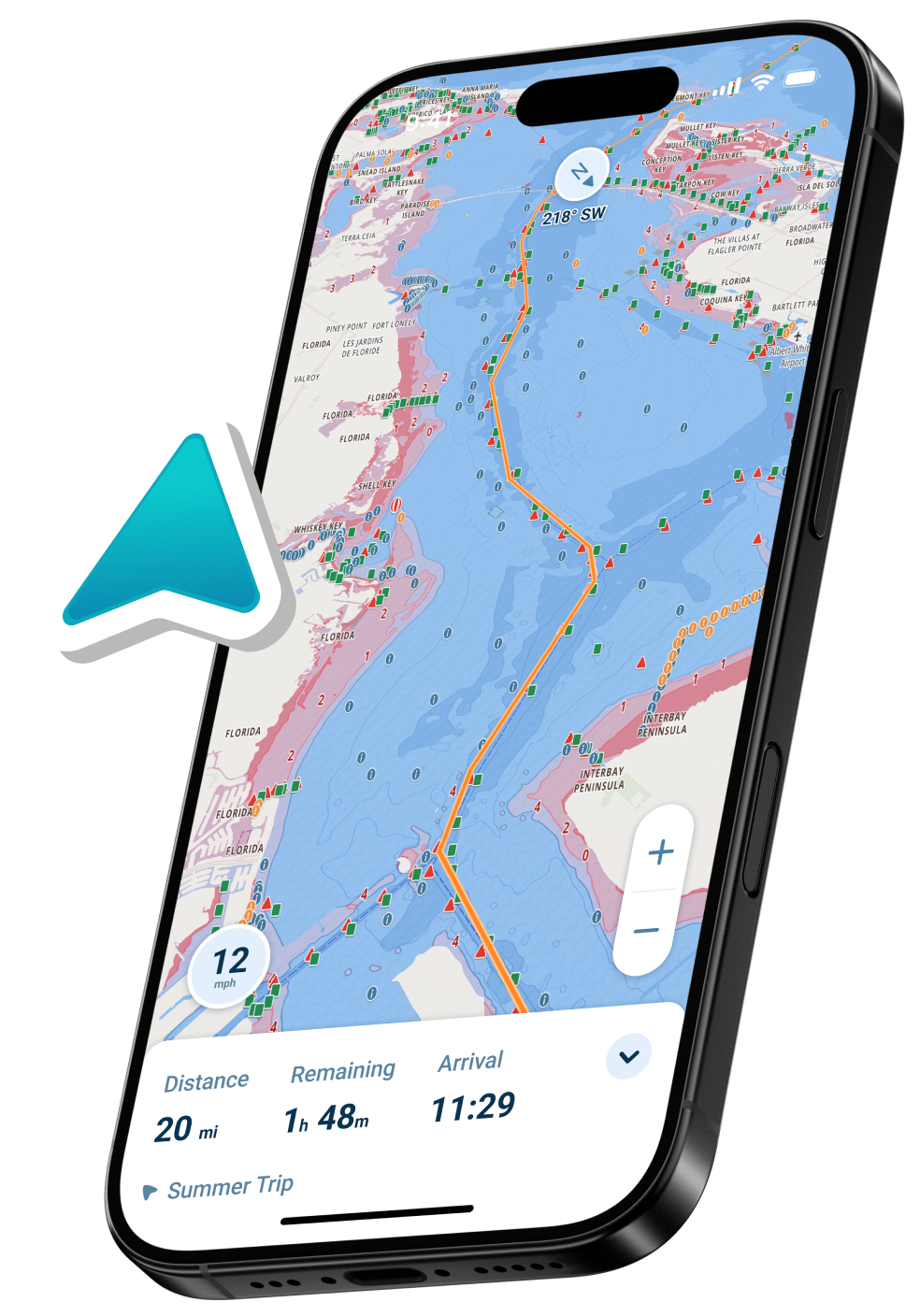
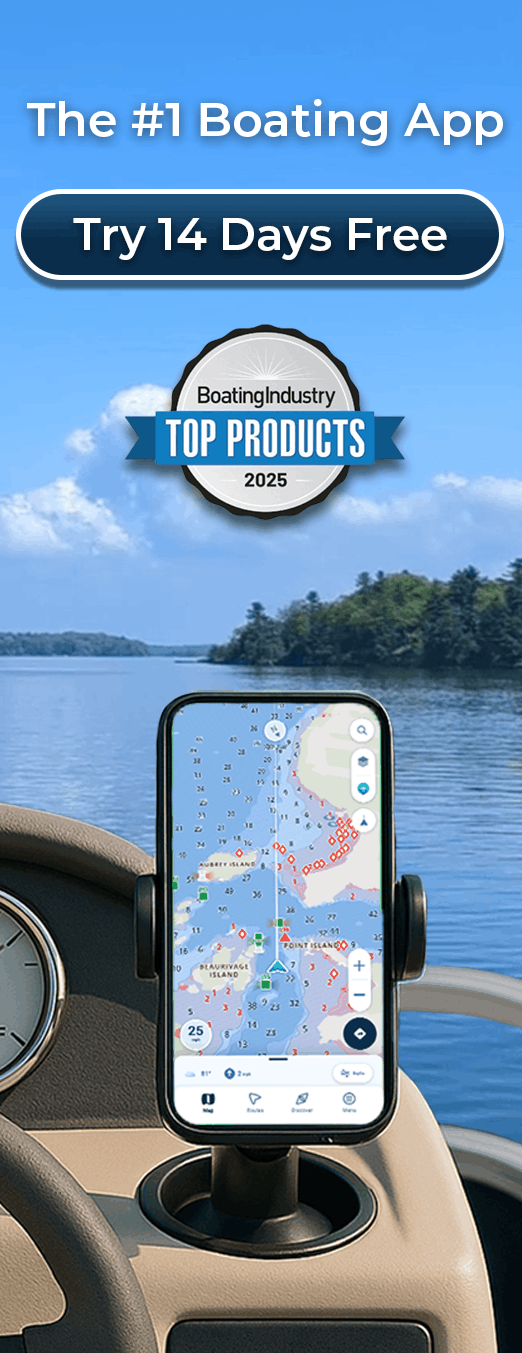
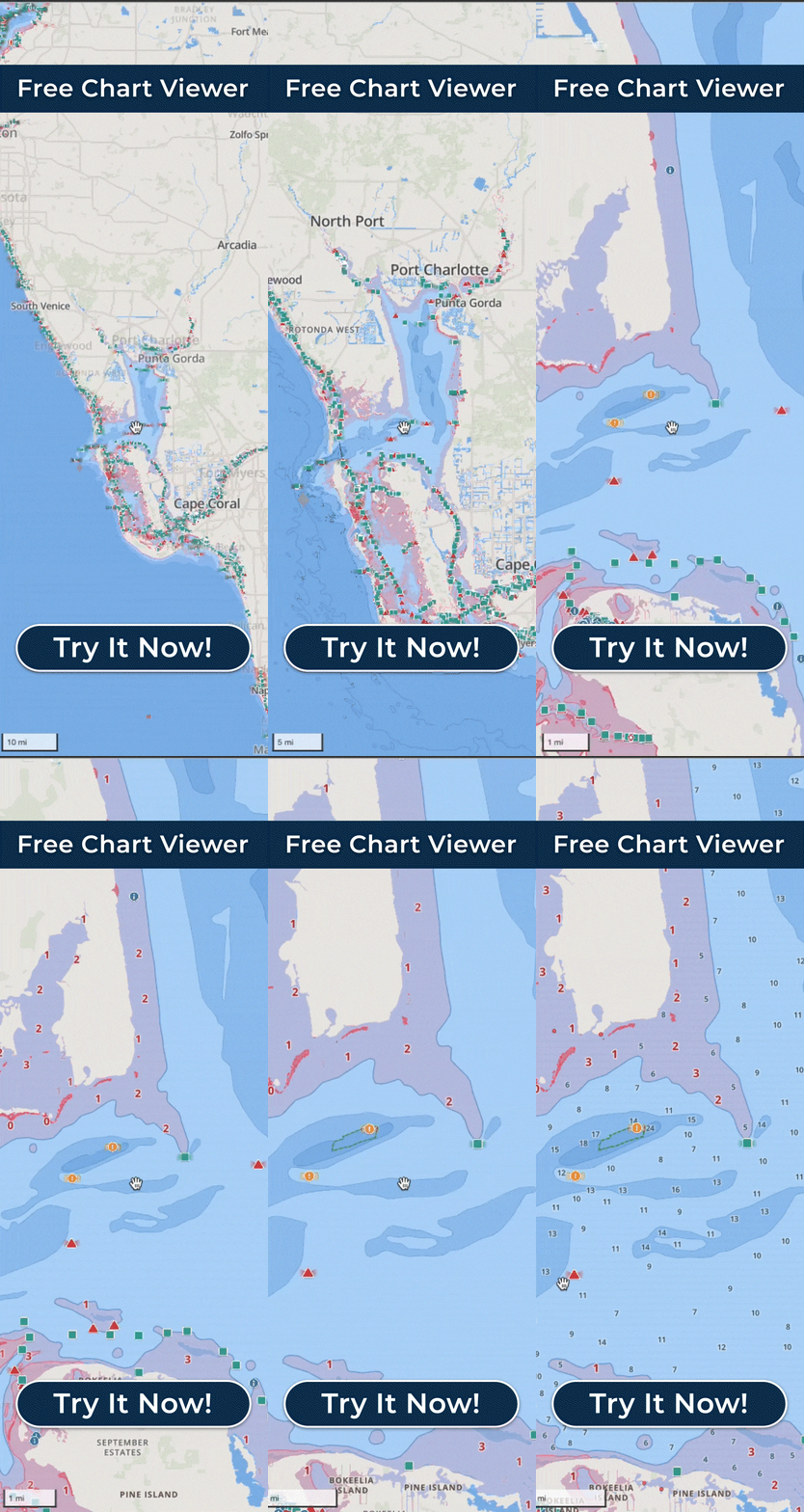
Wavve Boating represents a newer approach that combines official nautical charts with real-time draft-aware depth shading and integrated tide data. The system automatically adjusts depth visualization based on your vessel’s specific draft and current water levels, showing safe areas in blue and shallow zones in red without manual calculation. For Florida boaters navigating complex shallow environments, this automated depth awareness provides clarity that neither FMT tracks nor Navionics traditional charts offer natively.
The platform works on any iOS or Android device without requiring dedicated marine electronics, similar to Navionics’ flexibility but with additional features like community hazard reporting, marine weather integration, and simplified modern interfaces. Coverage includes all Florida waters plus nationwide and international charts, eliminating the regional limitation of FMT while providing more intuitive depth visualization than Navionics.
Understanding the full spectrum of marine chart options helps Florida boaters make informed decisions that match their specific vessel, navigation style, and budget rather than defaulting to the traditional FMT-versus-Navionics binary choice.
Making Your Decision
The choice between Florida Marine Tracks and Navionics ultimately comes down to four critical questions. First, where do you boat, Florida-only or multi-region? Second, what’s your draft, skinny water under 13 inches or moderate to deep? Third, what hardware do you have or are willing to buy, compatible with FMT or not? Fourth, what’s your navigation style, visual imagery or traditional charts?
Answer these honestly, and your ideal chart system becomes clear. If you’re a shallow-water Florida specialist with compatible hardware, FMT delivers unmatched local detail. If you’re a cruiser, offshore angler, or want device flexibility, Navionics provides broader utility. If you want modern features like automatic draft-aware depth shading and real-time tide integration, exploring newer alternatives makes sense.
Both FMT and Navionics are respected, capable systems used successfully by thousands of Florida boaters every day. Neither is “wrong”, they’re simply optimized for different missions. Choose the one that aligns with how you actually use your boat, consider your hardware situation carefully, evaluate your budget over multiple years, and remember that navigation technology continues evolving beyond these traditional options.
For comprehensive guidance on modern marine navigation and safety practices, exploring multiple resources ensures you make the best choice for your specific boating needs in Florida’s challenging and rewarding waters.
Frequently Asked Questions
Can I use Florida Marine Tracks on my Garmin chartplotter?
No, Garmin’s policy requires exclusive use of Garmin charts. Florida Marine Tracks only works on Navico hardware (Simrad, Lowrance, B&G) and Raymarine chartplotters. This compatibility restriction is one of FMT’s most significant limitations for boaters who already own Garmin equipment.
Is Navionics detailed enough for Florida shallow water navigation?
For moderate depths and well-marked channels, Navionics provides adequate detail. For extreme backcountry, unmarked flats, and technical skinny-water navigation under 2 feet, Navionics lacks the verified tracks and ultra-high-resolution imagery that make Florida Marine Tracks valuable in challenging shallow environments.
How often does Florida Marine Tracks update their charts?
Updates release periodically (not on fixed schedules) as ISLA Mapping verifies changes to markers, tracks, and imagery. Updates typically cost $50-$100 and aren’t automatic, you purchase new chip versions. This contrasts with Navionics’ included continuous updates within your annual subscription.
Can I navigate using just my phone instead of buying a chartplotter?
You cannot run FMT on phones, it requires dedicated chartplotters. Navionics works excellently on phones and tablets. Many modern marine navigation apps now provide professional features on mobile devices without hardware requirements.
Which system works better for night navigation in the Keys?
FMT’s verified tracks provide excellent confidence for night running if you’re comfortable following GPS tracks precisely. The tracks essentially provide a clear path even when visual references are limited. Navionics works for night navigation but requires more caution and careful attention to marked channels.
Does Navionics show the same detailed aerial imagery as Florida Marine Tracks?
No. While Navionics includes satellite imagery overlay, the resolution and clarity don’t match FMT’s ultra-high-resolution (3-inch to 1-foot) aerial photography. FMT’s imagery quality and detail density represent its primary advantage and main differentiator from all competitors.
What happens if Florida Marine Tracks data becomes outdated after hurricanes?
Storms can significantly alter channels, shoaling, and marker positions. ISLA Mapping works to verify and update affected areas, but there’s inherent lag time. Always exercise extra caution after major weather events regardless of your chart system, as no chart guarantees safety in dynamic shallow environments.
Content
- Florida Marine Tracks vs Navionics: A Regional vs Universal Chart Debate
- What Is Florida Marine Tracks (FMT)?
- What Is Navionics?
- Core Differences: FMT vs Navionics
- Coverage and Format
- Chart Style and Presentation
- Navigation Tracks
- Hardware Requirements
- FMT’s Verified Track Strategy
- Navionics Traditional Depth Display
- Everglades Backcountry Fishing
- Florida Keys Coastal Cruising
- Tampa Bay to Sarasota Bay Fishing
- ICW Navigation North Florida
- Offshore Fishing Trips
- Upfront Investment
- Long-Term Cost Structure
- Quick Comparison Table
- Who Should Choose Each System
- Modern Navigation Alternatives
- Frequently Asked Questions
- Can I use Florida Marine Tracks on my Garmin chartplotter?
- Is Navionics detailed enough for Florida shallow water navigation?
- How often does Florida Marine Tracks update their charts?
- Can I navigate using just my phone instead of buying a chartplotter?
- Which system works better for night navigation in the Keys?
- Does Navionics show the same detailed aerial imagery as Florida Marine Tracks?
- What happens if Florida Marine Tracks data becomes outdated after hurricanes?